- Home
- China
- World
- Asia-Pacific
- Americas
- Europe
- Middle-East and Africa
- Politics
- Business
- Opinions
- Tech & Sci
- Culture
- Sports
- Travel
- Nature
- Picture
- Video
- Live
- TV
- Specials
- Learn Chinese


Share







Copied
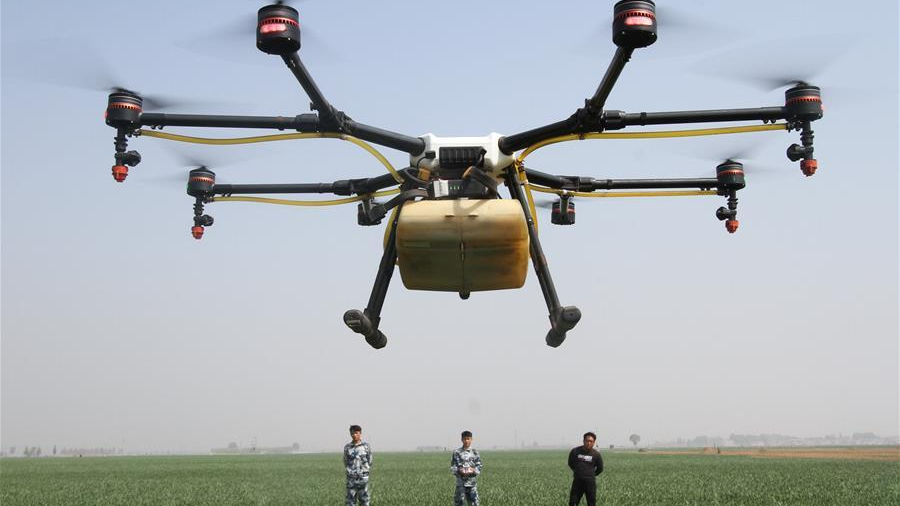
FILE PIC: An agricultural drone works in the fields in Beiguan Village, Linzhang Township of north China's Hebei Province, April 19, 2018. /Xinhua
Over the past year drones have become more relevant to people's lives according to the World Economic Forum. The technology has matured, and during the pandemic there has been a new urgency about finding new ways of accessing goods and services.
In Ghana, drones delivered 13 percent of the country's initial shipment of COVID-19 vaccine in just 3 days. In the United States, the Alphabet-owned drone delivery company Wing saw demand for its services double as people looked for contactless ways to get access to consumer goods.
In response, many regulators across the globe have demonstrated interest in helping this industry to expand its operations. They are granting more approvals under current frameworks, and also adopting more comprehensive frameworks to enable larger scale drone operations
Previously, drones were only capable of transporting light packages. But a new class of system is emerging that can carry 70 kg to 500kg loads, depending on the aircraft. This means that new delivery models can be more efficient and cost-effective than existing helicopter, truck, or ferry-based infrastructure, especially for goods that are of high social or economic value in areas that are not well served by current infrastructure. Remote, rural, and offshore communities can receive essential goods via autonomous aerial systems, if the right regulations can be put in place.
Heavy-lift drone delivery has recently reached a level of technical maturity, and the systems are ready for certification by civil aviation authorities. Approving heavy cargo operations may also serve as a bridge to platforms that carry people, such as Advanced Aerial Mobility (AAM) and Urban Aerial Mobility (UAM), as the technology is similar. AAM platforms have seen a rapid influx of capital. In the last six months, four companies - Joby Aviation, Lilium, Archer, and Elevation Aerospace - have announced plans to go public later this year.
Saudi Arabia could become a global leader in enabling heavy lift cargo solutions, and serve as a hub for emerging drone technologies.
Although the Middle Eastern country generally has excellent transportation infrastructure, some communities still have poor access to important medical and general consumer and industrial supplies due to complicated mountain, dessert, or water terrain.
The country's Vision 2030 notes a "significant backlog across the road network, leading to inadequate transport infrastructure," along with a strategic objective to "promoting ease/possibility of living across [the Kingdom of Saudi Arabia]." Heavy-lift drone delivery offers an opportunity to address these challenges and objectives.
However, regulation and business models lag behind and in some cases actively prevent companies from realizing the potential of this technology.
Public-private collaboration is needed to make sure cargo drones develop in a way that protects public safety, ensures community interests are represented, and considers how the integration of new technologies into supply chains is done in a cost-effective manner.
The World Economic Forum and the Centre for the Fourth Industrial Revolution in Saudi Arabia are initiating a heavy-lift drone project. This will support the Saudi Ministry of Transport and the General Authority of Civil Aviation to develop a regulatory framework, building on successful collaborations with Rwanda, Switzerland, India, and other governments on this topic.
The Forum also works with key stakeholders from the private and public sectors in Saudi Arabia to identify socially beneficial uses for heavy-lift drone delivery, and make sure the regulations support them.
(With input from World Economic Forum)
